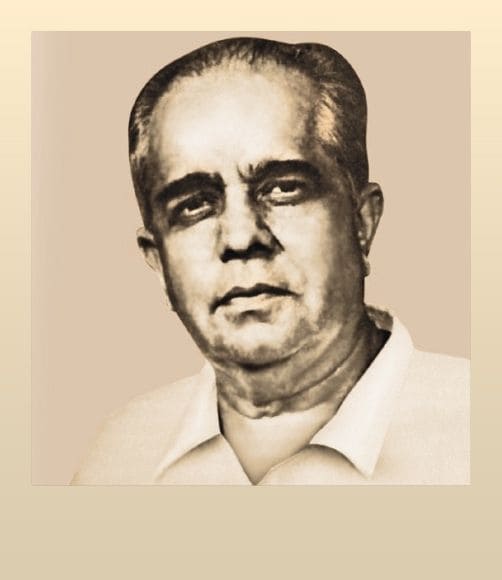
Late Dr. A. K. Talwalkar
An urban legend famous amongst the residents at the
K. E. M. Hospital in Mumbai, back in the 1940s was that
when Dr. A. K. Talwalkar took an incision to fix a patient's
fracture, the soft tissues would automatically move to
make way for him to reach the bone.
Such was the brilliance and surgical finesse of this man,
who did not attend regular school until the X Std, but
was home tutored. He would manage most orthopaedic
surgeries with a forceps, a knife, and a sponge.
Having completed his FRCS & M. Ch. from England
working under Dr. McMurray, he was the first Indian
surgeon to perform the Smith Peterson nailing and the
Austin Moore hemiarthroplasty.
He was the first Indian to attend the A. O. Courses and
not only propagated the correct internal fixation
techniques to Indian surgeons, but also helped
manufacture indigenous implants, like the bipolar
hemiarthroplasty prosthesis with the help of Inor
Orthopaedics.
He would attend every clinical meeting of the Bombay
Orthopaedic Society and make meticulous notes of
every case presented. At the subsequent meeting, he
would enquire with the presenter about the patient's
wellbeing. His Saturday clinics at the K. E. M. Hospital
were legendary and these would go on for one and a
half to two hours, where he would teach the Residents
with zeal and fervour.
Recognising his contribution in the field of Orthopaedics,
the Bombay Orthopaedic Society instituted the
'Prof. A. K. Talwalkar Symposium' as a plenary trauma
symposium at its annual meeting each year.
Dr. A. K. Talwalkar's orthopaedic legacy has been
passed on to his son, Late Dr. C. A. Talwalkar and his
grandsons Dr. Sumedh & Dr. Nilesh, who are practising
orthopaedic surgeons.